


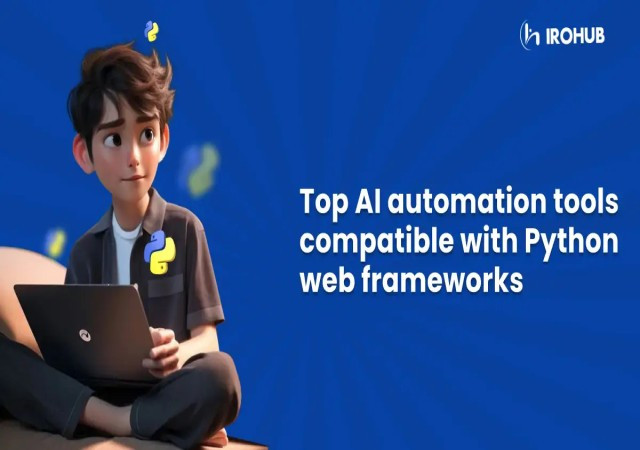
AI is emerging so much into our daily lives that it has been making automation easier, enhanced, and effortless. Python web frameworks are one of the best ways to build real-world Python applications, combining them with AI automation tools for quicker task execution and web development. With AI agents fast filling the markets, it becomes easy for web developers to plan, reason, and execute development ideas with little or no human intervention, while employees can focus on other priority requirements.
Thus, developers so confidently combine Python web frameworks with AI automation tools for their enhanced intelligence, workflows, and reasoning abilities. This makes it easy to complete multiple development goals in a shorter, quicker timeframe and also improves a developer’s overall productivity. This blog walks you through the top AI automation tools compatible with Python web frameworks, which benefits you in the long run.
Best AI automation tools that sync with Python web frameworks
Here’s the list of the best AI automation tools that work best with Python web frameworks:
GitHub CoPilot
GitHub CoPilot is one of the many tools that sync with Python web frameworks easily. This makes it easy for developers to identify the different code errors and rectify them on the go. It also makes it easy to generate boilerplates . Moreover, if you need assistance with adding certain specific features to your application but don’t know how to, then you can ask GitHub Pilot for suggestions and specific support. Some also use it for database management to write code using SQLAlchemy models and to answer certain SQL queries. This tool is also the perfect choice for a code rewrite by offering comments on how to improve or rework poorly written code. In short, it is best chosen for large Python AI projects that require quick completion and are mainly used for commercial projects.
Claude Code
Finding an error in the code and rectifying it is something that takes massive time and efforts for a developer. This is one such futuristic tool, also the dream of every developer, that auto-detects, rectifies, and replaces poorly written code. It also helps in executing certain commands and makes the apps and websites doubly simple and effective in the process. This is due to some of the sophisticated features it comes with, such as having sub-agents for repetitive tasks, MCP support for every new tool integration, and a headless support for CI/CD pipelines. Therefore, Claude Code is one of the best choices for developers who are looking to create app workflows, autonomous task delegation, and handling.
WindSurf
Have you ever heard of an AI automation tool that supports not simply one, but 70 programming languages? Meet Windsurf then. An able, efficient, and speedy code editor with a super-fast working Cascade age that coordinates and orchestrates the written codes more professionally. To balance the infrastructural cost, Windsurf is a freemium model tool which the developers can upgrade easily based on their usage pattern. The best part of Windsurf is the way it blends in with Python and recollects data from the past interactions. This is done using Python’s structural paradigms, architectural patterns, and APIs, which makes the whole development process easier. It is mainly used by polyglot developers who wish to be versatile with many programming languages, startup founders who aim for quick results, and noticeable MNCs who constantly face huge app development challenges and requirements equally.
Aider
This is yet another open source programming tool that blends with many other extensions like Claude 3.7, Sonnet, DeepSeek R1, and other such AI platforms. This makes it easy to find the pathway towards code development without having to consult the development team from time to time, makes voice-to-code conversions easy and effective, and puts limits on how much code can be developed at once so that the users need not go for a paid model unnecessarily. This is mainly used for apps looking for LLM flexibility and terminal-based workflows.
LangChain
This is another humongous AI automation tool that mingles well with Python. It comes with 600+ integrations or features that can be used for web development. Another feature highlighted about LangChain is that it follows an isolated approach in development for the entire LLM application development process. This tool best functions for applications that require a third-party integration where the database access and the confidentiality of user information are at risk. Also, the supplychain or the number of distributors who distribut this app are also required to scrutinize themselves and verify the app data before releasing it. On communication-based web apps such as Slack and Salesforce, it covers the data theft risks and keeps the communication data safe with end-to-end encryption.
LangGraph
LangGraph is one of the best chosen AI automation tools that separately works with Python or with its own framework, the Langchain. This makes it easy for the developers to extract any information, applications, or generate context-based texts without much difficulty. Therefore, it is often used in chatbots for bringing about context-based solutions for a specific query, summarizing and sharing a gist of bulk technical documents, and analyzing the code using LLMs. Based on the above-mentioned bulk and technical requirements, future-ready developer skills, LangGraph is used by financial institutions with a long customer history and data accumulated, tech firms, and mobile and application development companies.
CrewAi
Just as friendly as it sounds, CrewAi is one of the best beginner-friendly AI automation tools that developers often choose. The best part of it is that it manages the delegated tasks in a shorter time than what humans can perform. It comes with a two-layer management system that crews are used to learn automation and AI with Python. For web apps that need quick prototyping, CrewAi does justice to your requirements with built-in memory and RAG support. It is used by growing entrepreneurs who begin to face bulk needs and call for urgent technical support. To be truthful, it could take you some amount of time to get to know this tool.
Zapier
Taking a list of the most established AI automation tools with a Python framework, you’ll always find Zapier ranking at the top of the list. While it is easy to learn AI automation, organizations choose this tool for its no-code feature that makes it accessible and flexible to user needs. Thus, for all developers who shy away from web development in the name of a lack of technical knowledge, this can be compensated through a Python course in Kochi. This tool is chosen by companies that offer services to non-technical users, like Gmail and Slack, as it helps in the extraction of data for content creation or just makes the process of web development simple through content creation assistance.
PipeDream
One of the biggest requirements of every web developer is to simplify the process with no-code tools. In addition to this, if there were a choice to run serverless code, then the workflow could be more enhanced and manageable. The features of this tool have also been designed in such a way that the beginners get to understand them at the very first glance. Bonus point added in choosing Pipedream- it follows a subscription-based pricing model. This means you only need to pay as much as you use. This benefits from long-term usage, and you can code flexibly without any interruptions or glitches. If you are a developer who expects code flexibility from your tool, even while you’ve chosen self-hosting, this is the best choice you can make. Thus, Pipedream is the go-to choice for every non-technical and aspiring business owners.
Microsoft AutoGen
Developed by Microsoft, this tool specifically trains the AI agents for development through a structured group messaging practice. It instructs the entire web application through a human-in-the-loop feature using AI languages to convert the human typography into legible commands. Secondly, it also has an event-driven architecture, which guides the web application to follow the steps in a sequential order for development. For all these reasons, this tool is opted by large scale entreprises who collaborate with multi-agents through Microsoft platforms.
Future AI Automation Trends for Python Web Development
Here are some of the most awaited AI automation trends for Python web development that you would most benefit from. These trends are also said to bring about a massive change in the entire development process, predicting a soaring success rate of every organization’s performance:
Serveless AI Automations
Years are flying by, and in the next few years, the infrastructure will be self-handled by AI systems without having to assign a manual resource to do the same. With the help of well-trained AI agents, there would be a huge possibility of converting scripts into cloud workflows. This way, the scripts can be retrieved and revisited anytime the developers need them. There would also be serverless workflows, meaning that the workflows made using Python and automated AI tools can be used locally by every organization without heavily investing in a server for the long term. Most importantly, the web app development lifecycle will be fully automated. The security testing, performance testing, fraud detection, and mitigation will all be completely automated, saving the developers a lot of time and efficiency to work on other priority tasks.
SaaS HyperAutomations
The role of software testing and testers would also take on a new face, with not just automation but hyperautomation. Soon, there would be future-oriented frameworks like LangChain, which isn’t widely used at present. This would then make mundane tasks like code generation, database monitoring and management, workflow management, and deployment quite simplified. There will also be Robotic Process Automation (RPA) employed in every sector to enhance the development process to manage unstructured data and make effective decisions. With low-code and no-code generation, manual efforts towards automation could be saved. Altogether, this would improve the work environment, efficiency, and data management, which are some of the crucial aspects for an organization to succeed.
AI DevOps
AI DevOps is expected to be one of the major gamechangers as one of those AI automation trends for Python web development. This is because with AI DevOps entering the picture, development pipelines would replace manual testing with AI monitoring to weigh the performance of the web apps and to make them perform better. Then, there would be NoOPs (yes, that’s right!) where there will be minimal human intervention and requirement in the developmental process. Then, to eliminate the pitfalls of human security integration systems, there will be AI-oriented CI/CD pipelines by which the AI algorithms would monitor the AI integration and application delivery. In case developers face issues with the integration and delivery process, they will be offered an immediate, professional solution and support through AI ChatOps, where they will be guided and assisted by voice assistants.
Gen AI Web Apps
It’s time to leave these multi-page applications that consume a lot of space and energy on our devices. Instead, there would be AI-optimized apps that correlate to the user's needs better. These apps would have a shorter development cycle with fewer human efforts. These would also incur fewer costs in testing, and so the time to market is reduced by far. Also, as the repetitive tasks are handled and completed by the AI algorithms, the costs in testing, documentation, debugging, and maintenance would be fully nullified. This would be something that every future technology user would expect, leading to a hike in user expectations. With zero coding requirements or efforts put forth by fresher developers, technology breaks the barriers of development. This doesn’t essentially mean that the job of web developers would be taken away. Yet, there would be an increase in demand for every developer who has to gain industry-ready Python development skills and knowledge to handle these Gen AI web applications.
Automated Backend Operations
Coding is never an easy task, be it web, app, or hybrid development. Writing, editing, testing, rectifying, and retesting the code requires some amount of time that is probably unpredictable. Similarly, the security issues will be timely detected and corrected for the best user experience. Then, there will be a ‘Generative AI development standard’ that the Python developers and web applications must maintain. App owners will look up to those standards and accordingly demand or communicate their requirements. And finally, there would be answers to both ‘whys’ and ‘hows’ for Python development through hiring a developer who can master backend development using Django. In other words, the complex Python concepts will be broken down into simpler ones. The AI-oriented framework would work towards understanding the user requirements and, with basic human assistance, would work towards providing the best services across every industry.
Low Code AI Development
By the end of 2026, there will be a surge in the number of low-code web developers in every industry you can name. This is where AI Python development would play the role of a superhero and orchestrate websites in a fraction of the time. While developers would have to put basic efforts into low-code development, they would also be supported and corrected by the Python business logic powered by artificial intelligence. Secondly, there will be Agentic Workbenches where there will be several AI agents employed to look into the issues of the website or the app, reducing the efforts required in manual testing. Third, with the intervention of RPAs again, the repetitive development steps would be automated. And last, simply more than coding, these developers would be able to deploy fully automated low-code AI applications in a single click!
Winding Up
With productivity and manual efforts put forth as a big question in web and application development, Python in the future would release all the weight by combining with the best AI automation tools or help upskill with AI tools. From coding to debugging, everything would be automated and under the control and monitoring of the future technology, be it the job of one or ten. But, this essentially doesn’t at all mean that the job of developers would be fully automated or removed, making them unemployed in the coming decades. It would still require a level of experience and expertise to guide and mentor the AI tools to make them provide the nearest, best required output. This is something that IroHub Infotech is keen on while supporting the students’ career path. Employees must be on the lookout for the programming language in use, integration of AI commands, and the final output.
The time has come for employees to simply stop looking for courses that merely provide Python theories and practicals. You must, instead, start looking for programs that offer a course with a balance of theoretical and practical aspects, and an overview of future careers and how to upskill your programming career with Python. Moreover, these courses must have a good curriculum headed by experienced programmers and professionals. Ultimately, the course should leave you with some great takeaways that would help you flourish in your career and ultimately soar through and seek more competitive job roles with a better salary.
As you can see, with technology growing, opportunities are increasing, and the responsibilities and risks have been reduced. So better late than never to start looking for a career that can help you understand your present academic goals, take your past experiences and knowledge into consideration, and prepare you for a stable career!
Post Comments (0)