



Almost a year ago, Andrej Karpathy, a Slovakian AI researcher, said that AI will do the coding for developers and rectify the minutest errors while they can focus on other major tasks. And yes, it is true now. Code that AI writes for us is all the more powerful than what developers manually do. This clearly states that AI is a powerful technology that defines the future.
Both agentic coding and vibe coding function based on user behaviour and code quality. However, neither agentic nor vibe coding is about getting technical. Yet, having expertise and understanding the difference between the two helps in improving the customer experience and meeting timely requirements.
According to Hostinger, 30-90% of users have already switched to either of these practices. But what is agentic or vibe coding? What are the differences between agentic coding vs vibe coding? This blog discusses everything you need to know about these practices and helps you make the best use of them.
What is Agentic Coding?
Agentic coding is the process where AI gives complete, hands-on assistance in coding. It assists you in thinking, planning, knowing, analyzing, researching, reasoning, and executing your requirements. That gives an answer to what is agentic coding. For instance, it helps with making simple iterations that are mandatory, such as adding a search bar to an application, which requires minimal coding effort that AI can implement for you in a shorter time span.
What is Vibe Coding?
Vibe coding is the process of sharing the code with AI. Here, you should create a basic outline of the code and share it, after which artificial intelligence takes over. Then it evaluates and scrutinizes the input to identify what is missing. Accordingly, it includes the missing pieces of information and creates a more accurate output.
Why Should You Learn Vibe Coding?
Learning vibe coding can help the organization you work with in different ways, such as:
Quality Control: New Non-Technical Tools
Resolving technical issues manually takes more time and effort than developers can imagine. Vibe coding helps in analyzing these issues, reporting, presenting, and analysing them. In other words, it helps users explain a technical problem in a more non-technical way. Often, self-explanatory tools and platforms are developed using vibe coding by combining Gen AI with Python.
Some common examples of vibe coding applications are spreadsheet creation for HR, opinion collection for PPTs, and categorizing these needs into low risk, high maintenance, and high visibility.
Show Proofs to Stakeholders
Coding a website or an application often gets to its toughest phase when you need to convince the stakeholders, clients, and team that an idea would work. This requires you to create small, actionable snippets or demos for actual feedback. This way, the developer team works on the tasks as soon as they’ve been assigned. Here, vibe coding resolves integration issues faster than we imagine.
Increase Creative Innovations
Most clients ask for a demo before the software is released. It is the responsibility of the software developers to provide a demo to the stakeholders, clients, and team members to confirm and prove that an idea is implementable. Here, the stakeholders are assisted by verifying their software quality through getting feedback or actionable snippets that help them make the necessary changes confidently.
Improve User Encouragement
Most commoners usually seek the help of different tools to automate their repetitive tasks, like calculations in investments and expense management. However, before vibe coding is implemented in such cases, the organization would need to get approval from their IT support team to calculate the bandwidth they consume regularly. The bigger the needs, the better the vibe coding assistance would be. This resolves the bottlenecks in software development and handles real-time processes.
Who Should Learn Vibe Coding?
While vibe coding is becoming the talk of the town and a skill that makes hiring managers tick off a candidate, many applicants still have doubts about who exactly it could benefit. You can also start learning vibe coding if you’re a:
Non Engineer
In your future workplace, you might be required to work on functional coding requirements without a technical background. In such cases, you need no additional training or certifications except vibe coding. All you should be doing is communicating your ideas or validating them with the AI coding agents. And then, you should be able to code without digital expertise.
Experienced Software Engineer
As growing a part of the industry, experienced software engineers should inevitably stay away from learning vibe coding. This means that if you’ve got ample experience in the field as a software engineer, then you should also consider upgrading your position by imbibing the latest technologies as per the field requirements. This is only possible if you implement the right logic, speed, and practice.
Fresher & Creator
If you’re someone who loves to keep yourself updated with the latest happenings in development, then you probably must start learning vibe coding. Software development is one of the most in-demand job roles with a scope for immense learning and growth. If you’re a creator, then you should familiarize yourself with AI Studio and other similar technologies for consistent growth.
How is Agentic Coding Different From Vibe Coding?
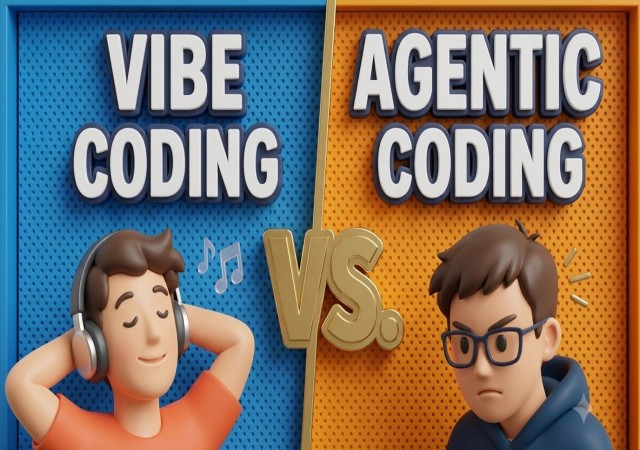
Though they seem similar, there are a few hairline differences between Agentic Coding and Vibe Coding:
Definitions
Agentic coding is the process of letting artificial intelligence code for you based on your goals and requirements while the AI agents make the necessary iterations. It is more like humans assign the tasks and the AI agents fulfill them.
Vibe coding is the process of coding for software development using human, casual language prompts for app development and progresses through a one-on-one conversation.
Human Support Required
In agentic coding, humans assign, monitor, read, and review the code received through AI.
In vibe coding, there is a two-way conversation with the AI agents.
Purpose
Agentic coding is mostly used for the orchestration of development plans.
Vibe coding is used for the development of tools, techniques, and basic planning.
Risk Levels
Agentic coding has a low risk regarding proper governance and legal binding.
Vibe coding has a high risk if left unmonitored.
Employability Levels
Agentic coding has a high employability rate if you’re good at engineering and writing.
Vibe coding has equal employment opportunities in all fields like medicine, engineering, and education.
Possible Failures
Slow automation or automation without oversight are possible failures to expect in agentic coding.
Failures in vibe coding could be bugs, security issues, or technical debt.
Agentic Vibe Coding: The New Hybrid Future-Ready Trend
While everything in technology is moving towards the future at a lightning pace, the future is preparing for the most powerful methods of software development- agentic vibe coding. In the simplest terms, agentic vibe coding is about training different AI agents to write code, run it, and test it while you, as the software developer, focus on language and creativity.
Job Roles for Students Who Master Agentic Vibe Coding
Agentic vibe coding is a whole new skill and talent that offers a plethora of opportunities who master the skills. While software developers stand out through skills and experience, this is one of the top knowledge sets that helps you stand out from the crowd.
Here are some of the top job roles for students who master agentic vibe coding:
AI Agent Developer
An AI agent developer is the brain of the AI agent and invests the required amount of time in planning how the agent should respond. They are responsible for combining different tools and business insights to pull real-time software needs that call for agentic vibe coding assistance.
They must also keep a watchful eye on different software requirements and their levels of complexity, which agentic vibe coding can cover in a short period of time with better efficiency. Working as an AI agent developer, you should also be able to cover real-time requirements. Similarly, you must be able to orchestrate and combine tools like LangChain and Zapier.
AI Automation Specialist
Even when the Agentic Vibe Coding is fully automated, there needs to be someone who can analyze the task and confirm that it is happening. They should be able to map out how AI should provide the final results. They must be able to evaluate the length, authenticity, and depth of the code to confirm that it’s reusable for future needs.
The outputs that you produce as an AI automation specialist should connect to CRMs, databases, and internal tools for results. Most often, they combine the code with tools like LangChain, Zapier, and n8n.
These are used to work on the legal compliance, safety, and security aspects of the software through AI assurance. They also enhance cross-cultural communication by automating prompts and edits regarding the software release.
AI Product Engineer
While product manufacturing and management is already a cumbersome process of giving the product specifications and details, an AI product engineer manages the requirements by refining the specifications with AI. They design what to build or make as part of the product and how to effectively actuate it with AI.
An AI product engineer uses RAG pipelines and features to solve real-world problems and meet upcoming requirements. The above-mentioned are also some of the main aspects that users look for while choosing a software product. This also helps customers understand which software products are available and ready to buy.
Multi-Agent System Engineer
While there are delegated agents for each software development type requirement, there is no one-size-fits-all for organizations. This is where a multi-agent system engineer works their magic by designing different aspects of a software system using different AI tools.
They also modulate and manage the prompts needed for this with expertise. Employing a multi-agent system engineer on board to decide the needed product features. This helps buyers understand the features available in the software and makes them purchase it.
AI Native Vibe Coder
An AI Native Vibe Coder should know how to create dashboards, landing pages, tools, and apps for various software requirements. Their main responsibilities involve inspecting and fine-tuning the hand-written code for clarity and authenticity.
The duties of this job role also includes cross-checking the AI outputs for bugs, bad architecture, and security issues, and resolving them. You are also expected to iterate on the code for quick adjustments. You may also have to adjust and verify the code cycles for quick use.
Myths About Agentic Vibe Coding
While a transition is inevitable, many software developers shy away from agentic vibe coding due to half-baked myths and unknown statements. Here are some such myths you need to stay away from:
Myth #1: Agentic Vibe Coding means you needn’t code at all
Fact: Not at all! As a software developer, you should still be working on coding, running the code, testing it, and implementing it. The amount of human assistance in the process defines the rate of success. Here, it is important to understand and monitor the whole process. Then, scrutinize and find out the loopholes or issues. Lastly, understand the security gaps and document them.
Myth #2: Agentic Vibe Coding reduces software development jobs
Fact: This specific process increases the requirements for software developers, not vice versa. Though AVC would help you with the code, you are needed to monitor the code for its architecture and writing. It is protected by the AI developer and multi-agent developers who keep the code intact. AVC helps boost growth and expansion possibilities.
Myth #3: AVC is good for prototypes, not products
Fact: Digital products always run on prototypes and not systems. Also, the contracts for SaaS products are often removed and replaced. Also, heavy gaps often adhere to the heavy contracts that are mutually agreed upon and signed as a deal. There is also a fixation on the payment processes.
Myth #4: One AI Agent can handle all builds
Fact: Complex builds in software are mostly handled by different AI agents for their speed, access to experience. Using a single build in a software application may complicate the process. These are simplified through software engineering roles like a multi-system engineer. These also come with greater learning capabilities for employees.
Myth #5: Code tested and automated after AVC is good to go
Fact: Simply testing the code and automating it after AVC is not the best decision to take. The organization needs to run through systematic security checks. Second- and third-party reviews also count. Automating code after prooftreading them is just the smart decision. Thus, the software refrains from touching the sensitive data.
Myth #6: Agentic Vibe Coding Needs Zero Assistance
Fact: AI making mistakes with agentic vibe coding could lead to serious errors like drift, data loops, and data loss. This can be verified if you’ve got a base in Gen AI with Data Science. Sometimes, clients would also want real-time deployment. Hence, there should be human assistance with deployment, ongoing checks, failed handoffs, and clarifications,
Myth #7: You need a computer degree to be good with Agentic Vibe Coding
Not at all. Agentic Vibe Coding is much in demand in the fields of design, product management, and production. This field drives success more with communication and strong verbal skills. In today’s hiring patterns, hiring managers weigh skills against portfolios and respect the efforts and learning enthusiasm of the graduates. The basic knowledge you need to possess is all about debugging and reviewing code.
Myth #8: AVC only works for software and technology needs
No. Agentic Vibe coding is not simply a technical skill for the engineering teams to master. It is used by HR management teams for marketing campaigns, to simplify planning and management decisions, and to orchestrate a workflow on the software. In other words, it deals with completing repetitive tasks. Therefore, it gels well with different field requirements.
Myth #9: Agentic Coding and Vibe Coding are Interchangeable
Agentic vibe coding and vibe coding are related but never interchangeable. Vibe coding only happens with the help of a human in the loop. This means that the code should be explained in a simple and broken-down manner for easy and quick understanding. However, Agentic Vibe Coding is fully automated and human-driven. Here, the AI agent plans, acts, and reports errors.
Myth #10: AVC is just a trend, not a Career
Market data is an opinion; vice versa. The smallest organizations have begun adopting Agentic Vibe Coding as a skill more than a piece of knowledge. There has been an increase in the number of job opportunities in the field too lately. The best part of having a career with Agentic Vibe Coding is that there are a lot of entry-level positions with higher salaries.
Closing Thoughts
Vibe coding or Agentic Vibe Coding, making the choice isn’t only about mastering the technical skills, but about understanding the requirements. In other words, it is a method of adding something valuable to something real. A software engineer increases testification, verification, and accountability through Agentic Vibe Coding. If you are awaiting a high-paying salary role that makes you stand out, start adapting to AVC to mark the change.
FAQs
Does agentic vibe coding mean fewer opportunities?
No. Agentic Vibe Coding means getting a career upgrade with a challenging role and competitive salary.
What is agentic coding?
Agentic coding is where AI gives complete, hands-on assistance in coding.
What human support is needed in agentic vibe coding?
While the algorithms do the coding and complete the development, humans need to scrutinize them.
Do you need coding knowledge for agentic vibe coding?
Yes, you must have some basic coding knowledge and a good language for agentic vibe coding.
What is a minor pitfall of agentic vibe coding?
Slow automation or automation without oversight is one small pitfall.
Post Comments (0)